

If Money Is Power, What Is It Powering?
Why spirituality belongs in the boardroom.
Hello to all you builders, breathers, and bottom-line re-thinkers!
What if the real disruption we need isn’t just technological… but spiritual?
We live in a moment obsessed with optimization—faster growth, higher returns, sharper edges. And yet beneath the spreadsheets and quarterly reports, many leaders are quietly asking a more ancient question: What is all this for? What kind of legacy are we actually building?
This week being an off week for the Soul Boom podcast, we wanted the opportunity to share with you an adapted excerpt from a book that addresses these very questions—by friend of Soul Boom, investor and entrepreneur Jenna Nicholas. In her best selling book Enlightened Bottom Line, Jenna explores what happens when we stop treating spirituality as a weekend hobby and start allowing it to inform how we move money, build companies, and shape institutions.
Why share this with all you Soul Boomlets? Because if we’re serious about a spiritual revolution, it can’t stop at meditation cushions and meaningful conversations. It has to reach boardrooms. It has to reach capital flows. It has to reach the systems that shape everyday life. As Rainn blurbs for the book: “Jenna Nicholas masterfully explores how spirituality can inform and elevate our financial and business choices. Her book is an invitation to rethink success—not just as profit, but as purpose and positive impact.”
What follows is an adapted excerpt that asks what it might mean to measure success with the soul in mind.
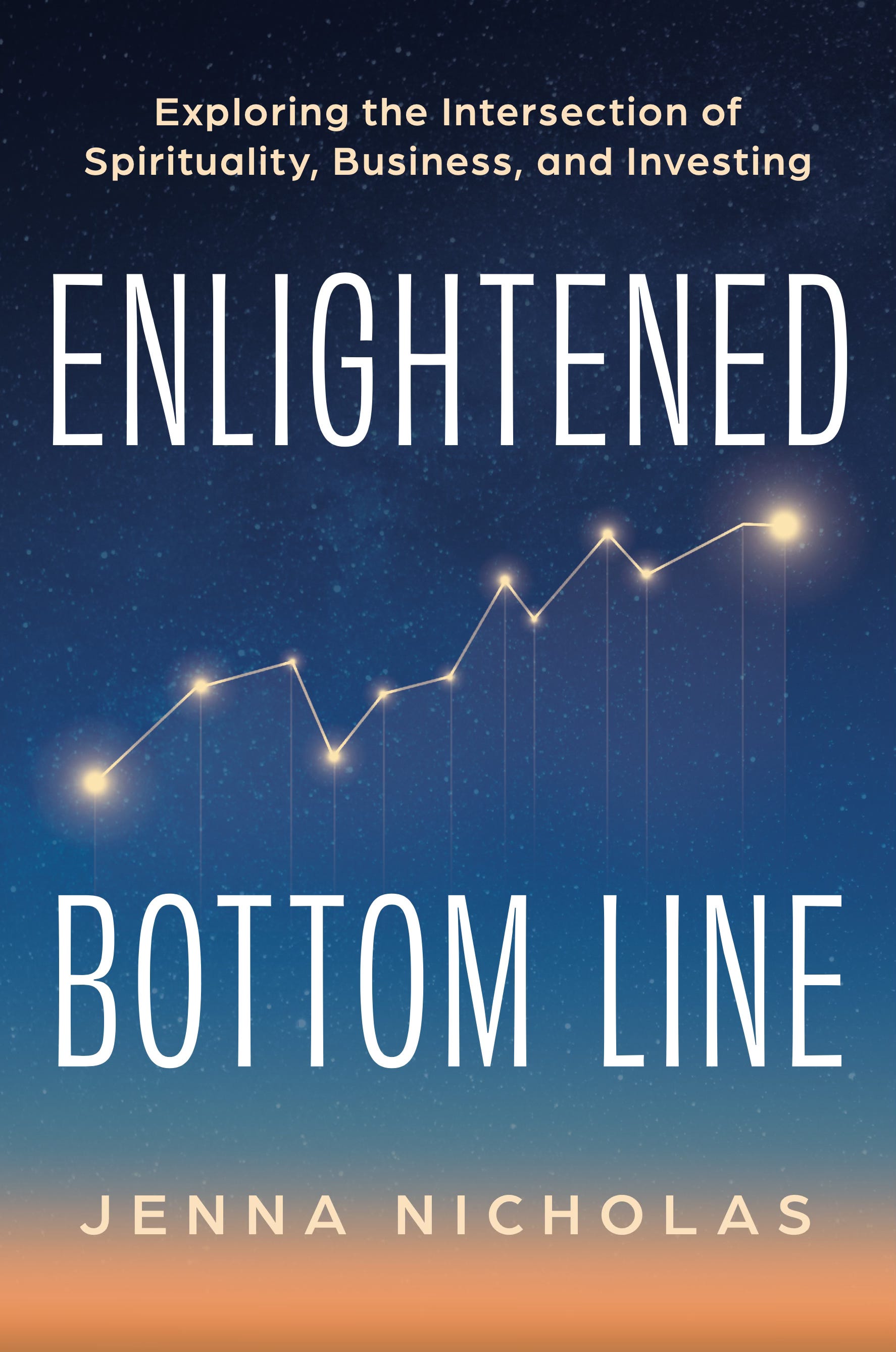
An Enlightened Bottom Line?
Have you ever wondered what your tombstone might say? If you had to—honestly—reduce the sum of your impact on this world to a single line, chiseled in stone, what words come to mind? That is exactly what my colleague Wayne Silby was asked to do at a Buddhist retreat back in the 1970s, soon after he founded Calvert Funds. At the time, he had been hustling to compete in a high- paced investment market, and his reflections yielded a nightmarish vision of his earthly “achievements”:
‘Here lies Wayne, who made 2 percent more than the next guy.’
Needless to say, this was not the legacy Silby wanted to leave. Upon his return to the office, he led his entire management team to reflect on their overall purpose in building an organization. Silby wanted to make a positive impact in addition to driving financial success, so the company laid out its mission to meet the needs of return-seeking investors today while also focusing on the long-term needs of our planet and society. Calvert has since become a pioneer in the area of socially responsible investing, with approximately $45 billion in assets now under management. Some examples of Calvert’s impact include investing in health technology companies that innovate diagnostics for early detection of major diseases and investing in education technology companies that democratize education. Overall, the firm’s work has played a significant role in shaping the trillion-dollar impact investing industry… and it all started with a meditation on life, death, and legacy.
Again and again, business leaders and investors have shared with me their stories—moments that cracked them open, that unsettled and remade them. Often their voices would drop and their eyes would search for reassurance as they confessed, “I don’t really feel like I can talk about this, but . . .” They next speak of dark nights of the soul, of wrestling with doubt and emerging with new clarity that reshapes not only their lives but also the very organizations they lead, found, and invest in. They shared moments of personal hardship or loss, combined with pressure to make business or financial decisions that did not align with their values. Many of these courageous individuals chose to take a chance on their higher natures and lean into those values, prioritizing people and our planet over mere profits alone. And they managed to do all of that while also steering their organizations toward greater success.
These stories, when honored and integrated, become the roots from which purpose-driven businesses and investments grow—ventures that nourish not just balance sheets but also the balance among business, communities, and the land itself.
Throughout my career and studies—from London to China to Silicon Valley and through my time at Stanford as an undergraduate and at the Stanford Graduate School of Business—I have walked many paths. I have invested in health care, climate, and education and built coalitions of over 170 foundations, representing more than $50 billion in assets under management to move capital from fossil fuels into impact- driven solutions across asset classes. I co-founded Impact Experience in 2015, an impact-driven organization designed to build bridges between investors and underestimated communities. Again and again, I have witnessed what happens when spirituality gets involved, not as an afterthought but as the very heartbeat of decision-making. Through my work with Light-Post Capital, I invest into and acquire companies addressing some of the great challenges of our time. When we measure not only our return on investment but also our return on impact, we create ripples that nourish the world.
This work is certainly not mine alone. I have learned alongside visionary leaders and changemakers who believe, fiercely, that money can become medicine. Together, we have asked, How can we use our resources to heal, uplift, and meet the urgent challenges of our time? How can we infuse our financial choices with joy, integrity, and freedom? The word spiritual comes from the Latin spiritus, meaning “breath,” the animating force of life. This leads me to wonder:
What if we breathed life into our financial systems, infusing them with purpose, consciousness, and the recognition that we are all connected? Just as breath sustains our bodies, a spiritual approach to business and investing can sustain our communities, our ecosystems, and our future. When we remember the root meaning of spiritual, we begin to define wealth not only as money but also as the living, breathing well-being of people, relationships, and the planet itself. To me, a spiritual person is not someone who has arrived but someone who strives—who returns, again and again, to the work of growing, reflecting, and caring for others. I often fall short, but I take heart from the words of Bahá’u’lláh, the nineteenth-century founder of the Bahá’í Faith: “Rest assured and persevere.”
In my opinion, the true measure of spirituality is not perfection but the willingness to try, to reflect, and to begin again. In business, this means creating cultures of hope, compassion, and mindful communication—workplaces where creativity and innovation can flourish because people are seen and valued. Throughout the book, I often write from the perspective of my own faith, the Bahá’í tradition, which teaches that all religions share an underlying unity and that the world’s economic challenges require spiritual solutions. The Bahá’í writings offer practical guidance on profit sharing, decision- making, and the roles of management and labor, all rooted in principles that honor our interconnectedness. Business need not be at odds with spirituality; indeed, it can become a powerful force for material and social progress. The Bahá’í vision is nothing less than the recreation of civilization—a world where spiritual principles infuse every institution, from families to global governance.
There are many more examples of thought leaders and change-makers from various industries and spiritual traditions who are trailblazing their way toward creating a more equitable and just world. These leaders integrate spiritual values into the way they use their money in business and investment decisions. They are investors who champion sustainable agriculture, CEOs who partner with local communities, founders who innovate renewable energy sources, and so many more. I have interviewed individuals from all walks of life whose perspectives, insights, and experiences provide a multi-faceted exploration of these transformative ideas. A foundational framework revisited throughout the book for integrating spirituality into investing and business is the HEAL model: hope, empathy, abundance, and legacy. Among the people I’ve interviewed, these themes consistently emerged. An enlightened bottom line asks us to bring our whole selves to work, aligning our personal values with our professional choices.
Too often those in finance and business feel they must leave their deepest beliefs at the door, practicing values-driven activities only in their spare time. Many spend their workweeks focused solely on maximizing shareholder value, only to compartmentalize their sense of purpose into a few hours of volunteering on the weekend. But business and impact do not need to be so disconnected. We can align our work and our values so that purpose becomes part of how we create value every day, not just as an afterthought but as a key driver of every decision, every relationship, every investment.
Adapted from Enlightened Bottom Line: Exploring the Intersection of Spirituality, Business, and Investing by Jenna Nicholas.

Jenna Nicholas is an investor, entrepreneur, and best selling author working at the intersection of capital and conscience. She is President of LightPost Capital and Co-Founder and CEO of Impact Experience, advancing equity across climate, healthcare, education, and investments. An active angel investor who has backed multiple unicorns, she has previously worked with the World Bank Treasury on green bonds, led acquisitions as an Investment Partner at One Planet Group, and helped mobilize over 170 foundations representing $50 billion in assets to shift capital from fossil fuels and invest in impact solutions. A Stanford MBA and Forbes 30 Under 30 Social Entrepreneur, Jenna has been featured in The New York Times, Financial Times, and Forbes. Her work reflects a commitment to aligning spiritual principles with business and investing. She is an active member of the Bahá’í Faith. More info here.

Also, Soul Boomlets — many of you know Rainn has a special connection to Haiti through LIDÉ Haiti, the arts and literacy organization he co-founded to support young women and girls there. In that spirit, we want to spotlight a powerful new documentary recently released: The Forgotten Occupation: Jim Crow Goes to Haiti, directed by Alain Martin and executive produced by Roxane Gay. The film revisits the U.S. occupation of Haiti (1915–1934) and traces its lasting impact through a deeply personal lens. It’s now available worldwide to rent or purchase on Apple TV, Amazon, Google Play, YouTube Movies, kweliTV, Gathr, and Vimeo On Demand, with educational access via Kanopy. We encourage you to check it out.

Wow, this is going to sound terribly simplistic to all those business types out there, since I have never worked in the business world more than a few months at most. I was fortunate to find my career in academic librarianship, where I, personally, didn't have to worry about the bottom line. The thing that separates that culture from the world of business is that instead of competition, our work centered on collaboration, on sharing resources with other institutions to solve the problems of our "customers," both internal and external. Of course, there is a business model in place within the academic institution itself, and the university competes for students. But as service providers within that structure, we only had to worry about problem solving and service to our clientele. A very wise man who was a successful and much loved salesman once told me that he didn't think of himself as a salesman, but as a problem solver. Here's another wise saying: The customer is not always right, but s/he is always the customer. In my own idealism I honestly feel that if a business can sincerely put the welfare of the population that it serves before the optimization of its profits, then that would be the greatest power of them all.
I can understand corpocratically-inclined and extreme-wealth Americans supporting the likes of Trump’s past soulless — hell, completely un-Christlike — and most morally ugly Big Beautiful Bill.
But there are so many voters and elected Republicans who claim to be Christian yet defend, or at least are noticeably quiet about, the bill despite its ultimate cutting of access to health services and food aid/supports for the poorest Americans.
It’s bad enough for the Trump government, that’s widely supported by the institutional Christian community in American, to cut whatever minimal government support there is for poor people, especially children, lacking food and/or those without access to privately insured health care. But to do so in large part to redirect those funds via tax cuts to the superfluously very wealthy — including those who have no need for more money, and likely never will — is plain immoral.
The money will mostly go towards an attempt to satiate the bottomless-pit greed of unlimited-growth capitalism and hoarded wealth. It’s morbidly shameful conduct by a supposedly Christian nation’s government, which is largely politically supported by institutional ‘Christianity’ in America.
And while Trump is pulling the wings off of many Americans who materially have little or nothing, he only further exposes his administration’s fraudulent, bastardized version of genuine Christianity.