

Dr. Theresa Bullard on Real Alchemy
She Explains to Rainn Where Physics Meets the Mystical
What happens when a physicist starts asking questions that physics alone can’t answer?
In this week’s Soul Boom, Rainn sits down with Dr. Theresa Bullard, a physicist whose journey has taken her from the University of Washington—where she earned her PhD—to an exploration of consciousness, Kabbalah, alchemy, ancient metaphysics, and the places where scientific and spiritual inquiry might intersect. After immersing herself in the teachings of the Western Mystery School tradition, she eventually became host of Mystery Teachings on Gaia, where she explores topics including consciousness, metaphysics, and the relationship between scientific and spiritual perspectives.
The conversation between Rainn and Theresa begins with her describing a tension she experienced firsthand. Within academic science, she says, spirituality wasn’t necessarily forbidden as a private belief—but bringing it into scientific conversation could put your credibility at risk. When she became interested in studying consciousness, she recalls being warned against embarrassing her physics department with “soft science.”
Theresa argues these questions are not at all “soft” and that knowledge about our physical universe by itself isn’t enough. Humanity already possesses tremendous technological capabilities and many of the resources necessary to reduce suffering. What we often lack is the collective will to use them for the good of the whole.
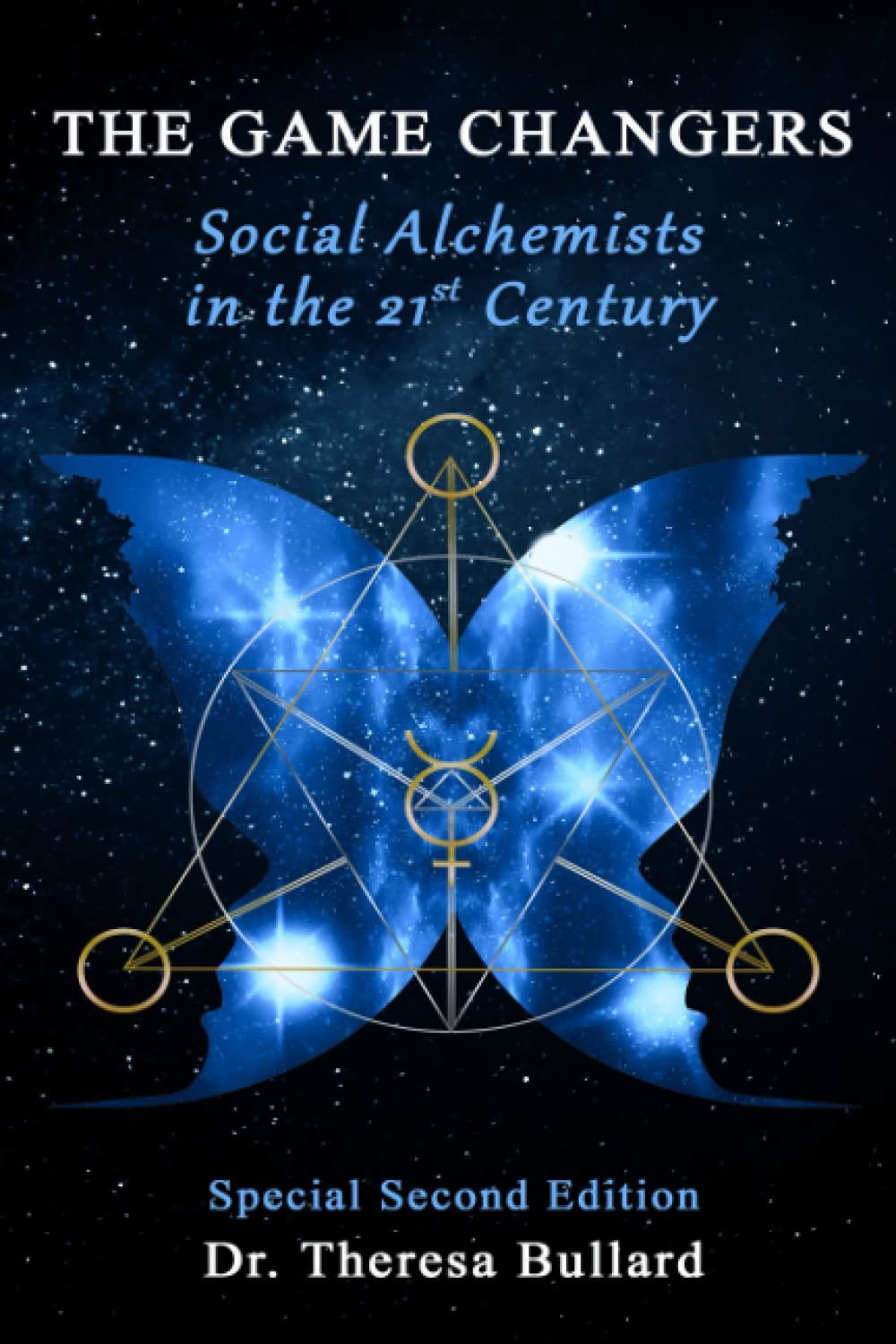
It’s an idea that connects directly to Theresa’s book, The Game Changers: Social Alchemists in the 21st Century. The book asks what it takes to become an agent of meaningful change in a world whose problems cannot be solved simply by accumulating more information. Drawing on her unusual combination of scientific training and metaphysical study, Theresa presents “social alchemy” as the work of transforming ourselves so that we can participate more consciously and effectively in transforming society. The emphasis is not merely on personal awakening, but on developing our human potential in service of something larger.
That same movement—from individual transformation toward the healing of a larger whole—appears when Theresa turns to the Kabbalistic concept of tikkun, an idea that alludes to the Jewish concept of tikkun olam, or “repair of the world.” Theresa describes a Kabbalistic creation story in which an original divine unity shatters, scattering “shards of light” throughout creation. The human task, as she explains it, is to heal, rectify, and reunite those fragments. She connects that cosmic process to our own lives: healing the fractures within ourselves so that we can participate in a larger work of restoration.
As she tells Rainn, while beginning to study Kabbalah, she was also attending lectures in astrophysics, and it was during that time that Theresa was struck by what she perceived as parallels between ancient accounts of creation and modern cosmology. She explains the Tree of Life, gematria, and Kabbalah not simply as a collection of esoteric ideas, but as a practical system for understanding how to live, heal, and fulfill our potential.
Over the course of their conversation, Theresa gives Rainn intriguing answers to many vexing questions:
Is intuition real?
Does manifestation work?
What happens when we pray?
Does the brain produce consciousness—or receive it?
Why does meditation seem to work?
What does our gut actually know?
And, of course, the question Rainn tries to ask every Soul Boom guest:
What is the soul?
THIS is a conversation that I cannot WAIT to hear! To the podcast NOW!