

Greetings, fellow Soulfarers!
For this special weekend bonus edition, we have Part Two of Rainn’s conversation with journalist, author (according Rainn) “best podcaster who ever lived,” Ezra Klein.
Part One ranged from anxiety and our nervous systems’ uneasy relationship with modern life to mindfulness, uncertainty, and compassion — what Ezra beautifully called “a form of attention.” Part Two widens the aperture considerably: politics, democracy, spirituality, religion, pluralism, power — and the question of whether politics itself might be a spiritual practice.
Rainn and Ezra see eye to eye on a great deal. But when it comes to the long-term viability of partisan politics, there’s a little daylight between them.
So, a word about where we at Soul Boom are coming from.
We believe humanity can — and ultimately must — outgrow an adversarial model of democracy organized around political parties, nominations, campaigns, and the struggle for power. We imagine a higher, more ethical form of democratic life centered on the oneness and interconnectedness of humanity, in which our differences remain, but our common humanity and shared flourishing become the ground from which we navigate them.
We also harbor no illusions that we’re getting there anytime soon.
This is a generational project. Perhaps a project of centuries. In the meantime, we live in the world as it is, with the institutions we have, and with an obligation to make them more just, humane, and responsive to the people they serve.
We encourage everyone to be a responsible citizen and to vote. The point is that for our part, we’re less interested in pouring enormous amounts of energy into partisan ends — joining political parties, donating to political campaigns, and generally getting swept up in the whirlpool of partisan passions. We think the most vital work lies elsewhere: inspiring individuals, renewing human-centered communities, and building new institutions capable of embodying different ways of relating to one another. That’s where Soul Boom hopes to do its small part. Build enough of those, and perhaps someday the adversarial structures we take for granted will simply become obsolete.
That’s our take, at least. Ezra isn’t entirely on board with Rainn on this one. And that makes sense. For him, partisanship is a feature not a bug. After all, he has spent much of his vocation looking deeply into the machinery of politics, and his instinct is toward reforming and redesigning the institutions as currently designed so they can better accommodate the disagreement and pluralism inevitable in a diverse society.
But we wonder what you think, Soul Boomlets.
Can humanity eventually evolve beyond adversarial politics? Is organized political disagreement an indispensable feature of democracy? What might governance look like if it began from the premise of our fundamental interconnectedness rather than our competing interests?
While you chew on that, we’re sharing — with permission — a recent opinion essay from Ezra that feels like a fitting companion not only to Part Two, but to his entire conversation with Rainn.
On its surface, “Christopher Nolan’s Trojan Horse” is about Nolan’s The Odyssey. Beneath that, it is about something much older and much more immediate: strength and compassion, power and restraint, the stranger and the neighbor, the moral inheritance we have received and the civilization we are choosing to become. In an age when compassion itself can be derided as weakness, Ezra asks us to reconsider which qualities actually make a society strong. For our part, we’ll add that the Bible verse that most reflects Zeus’ law (in our humble opinion) is in Hebrews 13:2: “Be not forgetful to entertain strangers: for thereby some have entertained angels unawares.”
It feels particularly resonant after hearing him tell Rainn in Part One that “the enemy of compassion is passivity” and that “compassion is a form of attention.”
And with that, we hand the helm to Ezra.
— The Soul Boom Team

Christopher Nolan’s Trojan Horse
By Ezra Klein
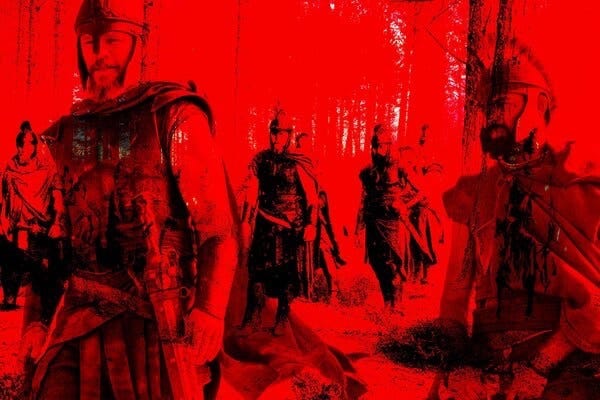
“The Odyssey” is the political movie of the decade.
I’ll admit I’m a little late weighing in on “The Odyssey.” Chalk it up to having young kids. I don’t make it to the movies much. But what a trick its director, Christopher Nolan, has pulled off. Elon Musk did not understand what this movie was. But this movie understands what Musk is. It understands who we are becoming and who we have become, and it points a way out.
Tricks are central to “The Odyssey.” In myth, Odysseus is a trickster. He is described, in the first line of the story, as the man of many ways or of many wiles or of many turns. He is, depending on the translator, an ingenious man, a cunning man, a complicated man. He is a man of appetites and contradictions, a man who wants nothing more than to go home but keeps choosing to stay abroad, a man who yearns for his wife but cannot stop bedding goddesses. Odysseus is never one thing; he is always many things.
Matt Damon is no trickster. I thought he was going to be the problem with Nolan’s “Odyssey.” Amid the right-wing outcry over the casting of Lupita Nyong’o and Elliot Page, it was Damon’s casting as Odysseus that I couldn’t reconcile with “The Odyssey.” Damon often seems to me like a man of a single way, a man who wakes up early and keeps to a clean diet and rarely has more than one glass of wine before bed. That’s not Odysseus.
But Nolan wasn’t looking for a trickster. His Odysseus is something else. That, you can say, was Nolan’s first trick.
I want to stop here and say a bit about tricksters, because I have spent the past few years quietly obsessed with the archetype. The trickster is Loki in Norse mythology, Eshu in Yoruban stories, Coyote or Raven in Native American tales, Maui in Polynesia and Hermes and Odysseus among the ancient Greeks.
The function of the trickster, writes Lewis Hyde in his wonderful book “Trickster Makes This World,” is “to uncover and disrupt the very things that a culture depends on.” The trickster dances across customs and taboos, says what may not be said, does what should not be done. The trickster injects disorder into order, renders visible what is ordinarily hidden. The trickster causes the damage that makes growth possible. But a happy ending is never guaranteed. The trickster can be regenerative or ruinous. Coyote brings fire; Raven brings the sun; Loki brings Ragnarok.
Hyde’s argument is that tricksters are both necessary and dangerous. They represent a tension every society must grapple with. A culture that cannot meet disruption with creativity cannot survive change. A culture that cannot protect its core values will be consumed by corruption. Too much order leads to paralysis; too much chaos invites collapse.
We are living in an age of chaos. We have been living in an age of tricksters. Musk, President Trump, Tucker Carlson, Andrew Tate, Nick Fuentes — the grammar of the modern right is tricksy. What is serious, and what is not? What is a provocation, and what is a promise? Why did they say that, and how did they get away with it? I am not saying these men are only tricksters. They are not the culture makers Hyde prefers to focus on. But I am saying that the dominant personalities of the age have gathered power by bulldozing customs and taboos, by saying what may not be said, by doing what should not be done.
Hyde said that Americans love a trickster “because he embodies things that are actually true about America but cannot be openly declared.” That might have been true in 1998, when Hyde published his book. And I can see the argument that American institutions and mores ossified in the years since — that our society had become too rulebound and bureaucratized, that too much had become unsayable, that there was too little openness to transgression and invention.
But today there is little that may no longer be said. The ideas and morals upon which the best of our culture was built have been disrupted and desecrated. The question now is whether that disruption can be met with creativity and renewal.
This is the central question of Nolan’s “Odyssey.” This “Odyssey” ostensibly hinges on Zeus’ law: Treat the beggar and the stranger as you would want to be treated. But as a horde of classicists have pointed out, that is not the law of Zeus, which is narrower: It demands hospitality toward the guest or the stranger, recognizing that anyone could be a god in disguise. It is not an ethic of compassion or even reciprocity.
And here we find Nolan’s central trick: Nolan has smuggled the core of Judeo-Christian ethics into “The Odyssey.” Zeus’ law, in Nolan’s “Odyssey,” echoes Leviticus 19:34: “The foreigner residing among you must be treated as your native-born. Love them as yourself, for you were foreigners in Egypt.” It echoes Rabbi Hillel, who said: “What is hateful to you, do not do to your fellow. That is the whole Torah; the rest is commentary.” It echoes Matthew 7:12, when Jesus says, “In everything, do to others what you would have them do to you, for this sums up the law and the prophets.”
Such an ethic is demanding. Few of us live up to it. But the problem with adherents of the modern right is not just that they don’t live up to it; the issue is that they detest it. To treat the foreigner residing among us as well as we treat our native-born is derided as suicidal empathy. The Trump administration glorifies cruelty toward the immigrant, the stranger, the weak and the poor. It takes money from Medicaid to cut taxes for the rich. It threatens the destruction of whole civilizations.
The modern right is built on the logic of tribute and dominance. “We live in a world, in the real world, Jake, that is governed by strength, that is governed by force, that is governed by power,” Stephen Miller, a top White House adviser, told CNN’s Jake Tapper. “These are the iron laws of the world since the beginning of time.”
But weren’t those iron laws replaced by the Golden Rule? When Odysseus concocts the trick of the Trojan horse, taking advantage of Troy’s veneration of the same gods he worships to sack the city and make its streets run red with blood, is he a hero or a villain? Is it a trick or a crime? To Homer, he was a hero. To Nolan, he is a soul in need of redemption. Between Homer’s time and ours came a revolution in civilizational values, an upending of what civilization even means. Which side of that divide are we on?
The modern right believes that Western civilization has lost the appetite for strength and dominance and hierarchy that built it. There is a reason a theorist like Bronze Age Pervert has become required reading for young Trumpists. There is a reason right-wing intellectuals like Curtis Yarvin and Michael Anton have mused about the need for an American Caesar. There is a reason the Trump administration is obsessed with Roman-style architecture. It is not an accident that they keep circling this era, both intellectually and aesthetically.
A recent exchange Musk had on X reveals how far this thinking has gone. A user told Musk it was time to “wise up” and abandon classical liberalism, because “universal suffrage leads to universal suffering.” His reply: “I have wised up.”
Helen of Troy, in Nolan’s “Odyssey,” is just an excuse for a war launched to dominate routes of trade. It’s a telling choice during an administration that is crashing into the global order in pursuit of more dominance over trade flows.
In the cry of protest by the Canadian prime minister, Mark Carney, against this regime, he also reached back to Greece to describe what he saw happening: “The strong can do what they can, and the weak must suffer what they must. And this aphorism of Thucydides is presented as inevitable, as the natural logic of international relations reasserting itself.”
When Nolan’s Odysseus recalls the sacking of Troy, he blanches at the memory of 10 years of rage pouring into a city in a single night. It was hard for me not to think, then, of the pent-up rage that Hamas poured into Israel on Oct. 7, 2023, and that Israel has poured into Gaza a hundredfold in the years since. The Israeli prime minister, Benjamin Netanyahu, now describes Israel’s future as “Athens and super-Sparta.”
Yuval Noah Harari, the Israeli-born historian who wrote “Sapiens,” sees the diminishment this foretells clearly. “A lot of the thinking, and also the practice, about what it means to have freedom of thought, what it means to be a powerless minority, was done by Jewish thinkers,” he told me. He added:
For 2,000 years, Jews all over the world saw studying and learning as the highest spiritual activity. After 2,000 years, you ask them: What have you learned? You have studied for 2,000 years. What have you learned?
And then people like Netanyahu tell you: Oh, we have learned that you need to be a Roman, that you need to be strong, that you need to build legions, that you need to destroy cities. This is the only thing that matters in life.
It’s a legitimate value system. Rome had its usefulness. But if after 2,000 years, the Jews simply become the Romans, what was the point? Why did you waste 2,000 years, then? You could have just become Roman back then.
This is Nolan’s finest trick: to make one of our oldest moral rules sound new again. To turn the best of Judeo-Christianity into the law of Zeus, so we can see why it might matter and what it might still have to say to us.
What Odysseus sees, eventually, is that his violations of the moral order have brought ruin to all around him. Agamemnon, the king who launched the war against Troy, is dead, his throat slit by his wife, who never forgave him for sacrificing their daughter for fair winds. Troy is destroyed. Ithaca, Odysseus’ home, is overrun by suitors who seek his wife and land and think nothing of murdering his son in their pursuit. Odysseus and his men were not fighting the barbarians; they were the barbarians. And their actions led to more barbarity.
So, too, has the political movement that rose promising to make Western civilization great again betrayed its inheritance. The world now looks at America and sees us as the barbarians: the country obliterating the global order, the country that takes what it wants and demands tribute from those who cannot resist.
And what the political opposition has to do now is recognize what Nolan recognized: That it is an affirmation of our civilizational values to say that cruelty is a weakness. That only compassion and reciprocity build a durable and decent society. That order is necessary but order without ethics and restraint is perversion or authoritarianism. That there is both beauty and wisdom in the injunction to avoid inflicting on others what we would not see turned against us and in remembering that we were strangers in the land of Egypt, too.
At the end of his book, Hyde considers when the trickster’s tale ends in ruin and when it ends in regeneration. His answer is that devastation comes when you cannot rejoin the worlds. Loki is bound beneath the earth, with poison dripped on him for eternity, and the end of the world is the result. Hermes becomes a connector between our world and the underworld, allowing Persephone, and spring, to return each year. In other words, it is only when severed worlds can be bonded that cultures can rediscover their strength.
I do not want to make this too didactic, so I will just end here: Justice in America has come, repeatedly, when those seeking progress realize that the language of the Torah, of the New Testament and of the Declaration of Independence can be wielded on behalf of a new world. It has been some time since religion, liberalism and patriotism had a comfortable relationship in this country.
But the shape of the modern right has created space to do that work again. Regeneration is hard. It requires seeing old values in new ways. It requires recognizing that a moral inheritance that has collapsed into cliché holds power in an age when it has been debased and forgotten. But it can be done. It needs to be done.
Nolan’s Odysseus is not a trickster. He is a man living in the ruins brought about by tricksters. So, too, are we. This movie, and the reaction to it, is a sign that the age of the trickster is ending.
Now we need those who would remake this world.
Ezra Klein joined New York Times’ Opinion in 2021. He is the host of the podcast The Ezra Klein Show and the author of Why We’re Polarized and, with Derek Thompson, the brilliant, best-selling Abundance. Previously, he was the founder, editor in chief and then editor at large of Vox. Before that, he was a columnist and editor at The Washington Post, where he founded and led the Wonkblog vertical. He is on Threads.
It was a great conversation:)