

Part 2: Fan Questions w/ Rainn & Oscar Nuñez
PLUS: Send your question to Rainn for a special fan Q&A episode!
Dear fellow travelers,
Before we dive into this week’s episode, we have a favor to ask.
We’re recording a special Soul Boom episode tomorrow that’s all about YOU.
Rainn will be answering your questions relating to all Soul Boom-adjacent themes: spirituality, mental health, purpose, relationships, grief, meaning—you know all the big and small things that make up the strange and beautiful experience of being human.
Leave your question in the comments below or email us at confessional@soulboom.com. We'll be recording on Friday, July 31, in the afternoon (Pacific Time), so if you'd like your question considered, please send it our way as soon as possible.
We can’t promise we’ll have all the answers. But we can promise to take your questions seriously.
Now, on to our latest episode...
If you haven’t checked out already, this week on the Soul Boom podcast, we have a special BONUS episode, featuring Part Two of Rainn’s conversation with his old friend and Office castmate Oscar Nuñez.
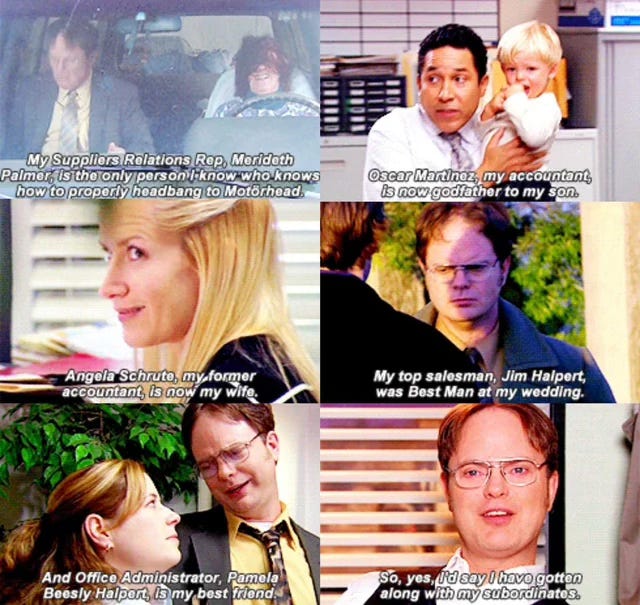
Of course, so much of what makes this bonus episode special really has to be seen. These are two very funny men with a long, rich history—one built over years of shared scenes, improvised glances, accounting-department hostilities, Schrute family entanglements, and, apparently, an inability to remember that Oscar Martinez is the godfather of Dwight’s son.
Of course, we love Office lore (both onscreen and behind the scenes) as much as anyone else—but we also loved hearing Oscar recount his rich family history—their flight from Cuba, their lost careers, his uncle’s imprisonment, and his own improbable journey through fashion school, dental technology, Bloomingdale’s housewares, improv comedy, and, of course, his arrival onto the set of The Office.
As we listened to all its twists and turns, an ancient Chinese story came to mind.
You might’ve heard to it referred to as “The Farmer and the Horse.”
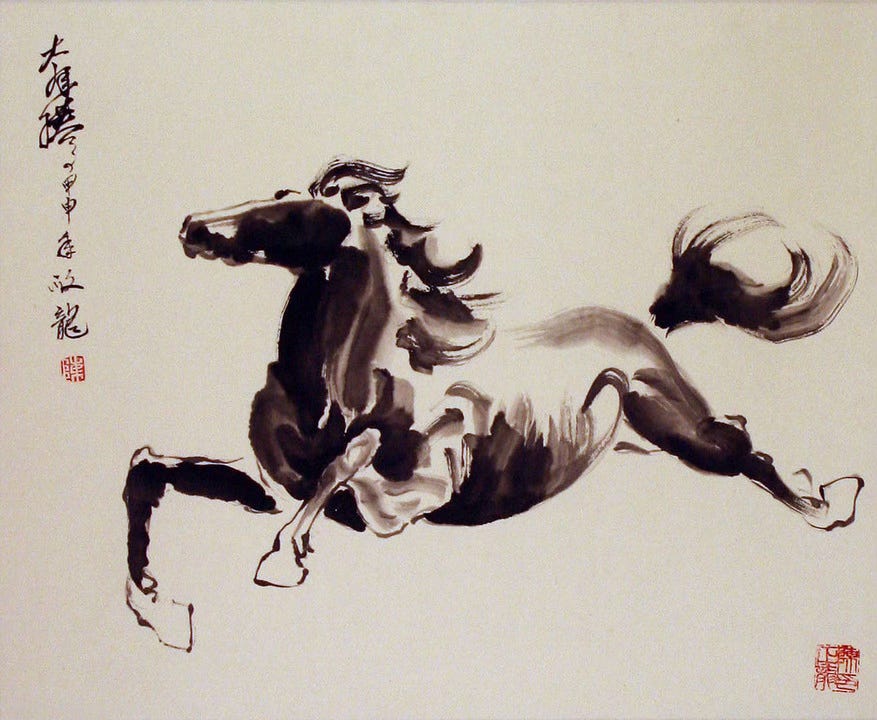
It comes from the Huainanzi, an ancient Chinese philosophical text compiled more than two thousand years ago. The chapter is called “In the World of Man,” which is a pretty good place to set a story about human beings repeatedly deciding what everything means while having absolutely no idea what will happen next. It goes like this:
A man living near the frontier loses his horse. Everyone comes to console him. Surely this is a terrible misfortune. The horse is gone. Very sad. Nothing complicated about that.
The man’s father asks: How can we know this will not become a blessing?
Several months later, the horse returns, bringing several magnificent horses with it. Everyone comes to congratulate the family. Wonderful! Extraordinary! The best possible turn of events! Bring out the frontier champagne!
How can we know, the father asks, that this will not become a disaster?
The family’s son loves riding the new horses. One day, he falls and breaks his thigh. The neighbors return with their condolences. Terrible news. Obviously terrible. No room for interpretive ambiguity here.
How can we know this will not become a blessing?
A year later, invaders cross the frontier. The able-bodied young men are called into battle, and nine out of ten are killed. Because the son is unable to fight, he and his father survive…
That’s where the story ends, but the point, of course, is that there is no end. As Orson Welles reminded us, whether you want to tell a sad story or a happy story, it all “depends, of course, on where you stop your story.”
Because that’s life isn’t it? Fortune becomes misfortune. Misfortune becomes fortune. Their transformations have no end, and their depths cannot be measured.
Or, as the old man’s repeated answer has come down to us in the story’s popular form:
Perhaps.
Oscar’s family knew something about those transformations.
A revolution that promised to free Cuba from corruption became an authoritarian regime. Oscar’s uncle, who had initially helped Castro’s movement, resisted when the government came for his ranch and spent twenty years as a political prisoner.
Oscar’s parents—an attorney and a dentist—left Cuba with their infant son and almost none of their possessions. Exile carried them first to Venezuela and then to Massachusetts, where a Catholic church and an American family they had never met helped them begin again. His father worked in a factory before retraining as a social worker. His mother, unable to regain her dental license, became a dental assistant and briefly practiced a little unauthorized home dentistry.
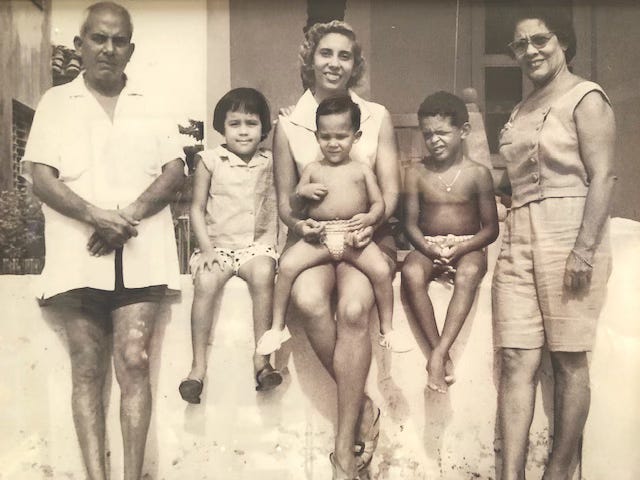
Their individual losses created possibilities for their children that they could not yet see. But those possibilities did not arrive in a straight line. Oscar’s path looked less like a carefully plotted career and more like somebody had spilled several careers onto the floor and asked him to pick them up.
He went to fashion school. Then he left fashion school. He became a dental technician. He was not a particularly good dental technician. Nearly everything he made had to be redone by his supervisor. He sold housewares at Bloomingdale’s. He found improv. And acting. Eventually, he found himself behind a desk at a midsized paper company in Scranton, Pennsylvania, silently judging Michael Scott.
Good fortune? Bad fortune?
Perhaps.
But the wisdom of the story is not that suffering is secretly good for us. That would be much too tidy—and, frankly, a little insulting. Political imprisonment is a deep, measureless trauma. Exile does not become painless because something meaningful later grows from it. Lost homes, professions, communities, freedoms, and years remain real losses.
The story asks something more difficult of us: to resist declaring that we understand the final meaning of an event while we are still living through it.
And don’t we do this constantly? We divide experience into victories and defeats, blessings and disasters, doors opening and doors being slammed directly into our faces. We want an immediate verdict. Was this good? Was this bad? Is life finally going according to plan, or has the entire cosmic administration once again misplaced the paperwork?
Then time rearranges the categories.
The failure leads to the vocation. The departure leads to the welcome. The life that did not go according to plan becomes a life no one could have planned. A rejected path becomes a redirection. A failed dental technician becomes one of the most beloved accountants in television history.
This perspective calls for a certain detachment—not indifference, withdrawal, or passive acceptance, but enough distance from the immediate drama to remember that the story is still being written. It calls for equanimity. Equanimity does not mean indifference to life’s joys and sorrows. It means allowing joy to be joyful and grief to be grief without pretending either one has revealed the whole story.
And perhaps that gives us a little more freedom to enjoy the process. To go for the ride without demanding that every turn immediately explain itself. To grieve what hurts, delight in what arrives, and remain open to what neither has finished becoming.
And, whenever possible, to do what Rainn and Oscar have somehow managed across decades: Laughing (and making us laugh) all along the way.

Now, hopefully, you’re feeling inspired to send us your biggest Soul Boom question for Rainn.
Leave it in the comments below or email it to confessional@soulboom.com.
We can’t wait to hear what’s on your heart—just remember we need them as soon as possible 🦄
Why do you think bad things happen to good people?