

Arthur Brooks on the Meaning of Your Life
Finding Purpose in an Age of Emptiness
Greetings, Meaning Makers 🌎✨
This week on the Soul Boom podcast, Rainn sits down for a second time with Arthur C. Brooks — Harvard professor, social scientist, and one of the world’s leading researchers on happiness, meaning, and human flourishing.
Arthur’s first visit with Rainn actually led to the two of them going on a journey to meet the Dalai Lama, all captured in a previous Soul Boom Dispatch.
In round two Arthur and Rainn dig even deeper into one of the most urgent questions of our time:
Why do so many people feel that their lives are… meaningless?
Arthur’s new book, The Meaning of Your Life, is his most distilled and deeply personal answer to that crisis. Drawing from decades of research in psychology, philosophy, and theology, he argues that meaning isn’t mystical vapor.
As Arthur tells Rainn, it took him five years to even define meaning well enough to write about it. He’d been staring at the data for years, noting that young adults have been reporting anxiety and depression at historic levels. One predictor rising above the rest: “My life feels meaningless.” And yet, in spite of his personal anxiousness about the subject, as a behavioral scientist, he felt he couldn’t write a book about meaning until he could answer the question: What is the thing people are missing?
Arthur offers one of the clearest explanations of meaning we’ve heard. In his telling, it’s derived from three essential elements:
Coherence — your answer to why life unfolds the way it does.
Purpose — why you are moving in a particular direction day after day.
Significance — the knowledge that the world would be worse for someone you love if you didn’t exist.
He also makes a crucial distinction: we tend to chase résumé virtues — money, status, applause — while neglecting the deeper “eulogy virtues” that actually make a life matter.
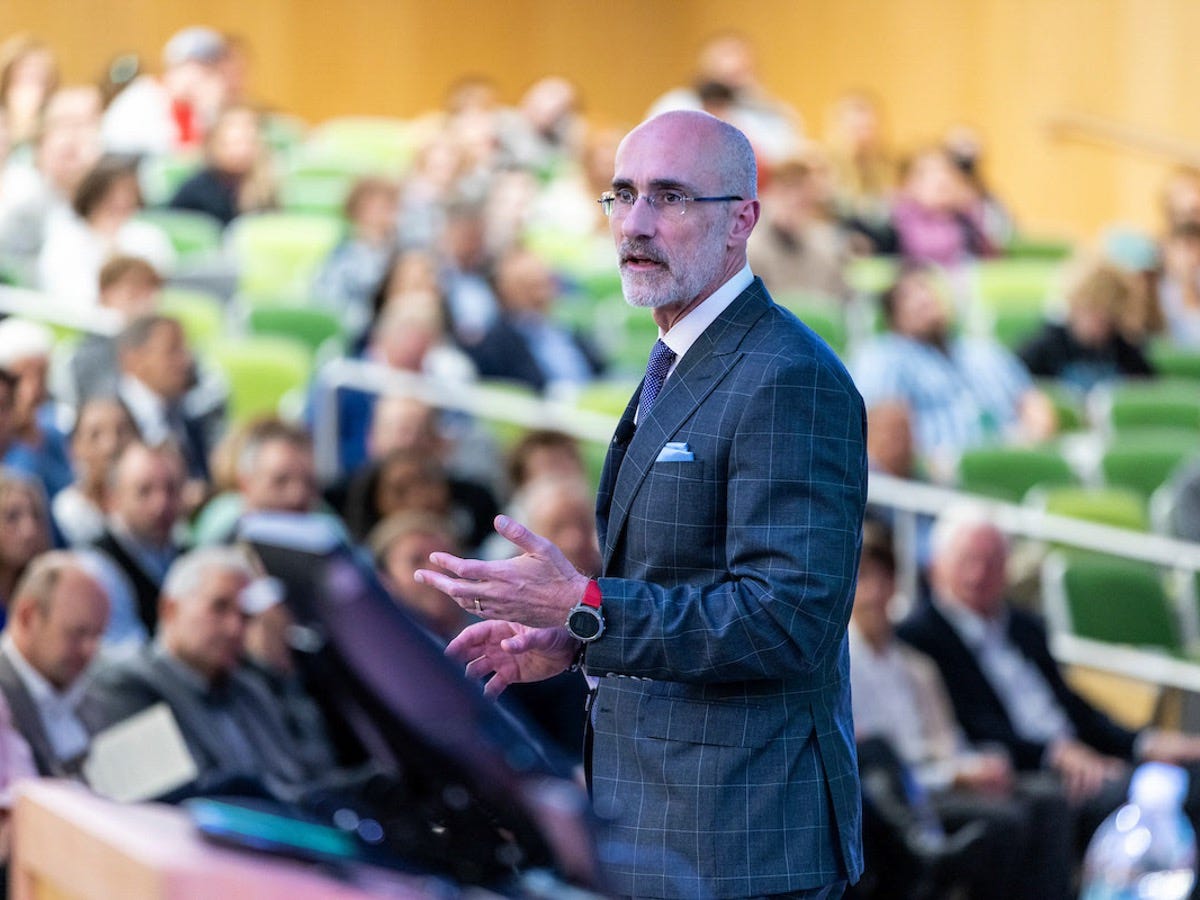
There’s a lot more in the book — indeed, as you’ll hear in the episode, Rainn loves it. (Like, truly—he was gushing about it before Arthur even got to the studio.) It’s one of those reads that’s hard to sum up, because it’s less a set of ideas and more a journey you move through. But one thing stood out to us. It’s when Arthur tackles the subject most of us would prefer to skip:
Suffering.
Arthur doesn’t frame suffering as an interruption of meaning. He sees it as central to it. Not something to avoid at all costs — but something that, rightly understood, becomes a source of growth, depth, and transformation.
Which brings us to something especially appropriate for Soul Boom.
In The Meaning of Your Life, Arthur tells the story of Rainn — yes, that Rainn — as a case study in how suffering, addiction, fame, spiritual doubt, and recovery can ultimately cohere into a life of purpose and service.
Because if we’re going to talk about meaning on Soul Boom, we might as well get personal. After you read it, we’d love to hear how you are finding meaning in your life.
Don’t Waste Your Suffering
Excerpted from The Meaning of Your Life
By Arthur C. Brooks
“I was such an insecure, warped creature that I needed that laughter to feel good about myself.”
This was the actor Rainn Wilson’s response to my question about why he’d always made jokes as a kid. He explains that when you are in a lot of pain but figure out that you are naturally funny, you start making jokes to distract yourself and others from your misery. It’s a kind of “emotional substitution,” he said.
I didn’t know Wilson when he was a child—although I easily could have: We are about the same age, grew up near each other in Seattle, and were both serious classical musicians. We became friends as adults and have bonded over our shared childhood experiences as well as common interests, values, and beliefs.
To meet Wilson as an adult, you would be hard-pressed to imagine him as an unhappy little kid. Today, he is a famous comedic actor, probably best known for his role as Dwight Schrute in the hit comedy television series The Office. His life looks charmed—as do, come to think of it, the lives of the people we met in the introduction. But, of course, looks are deceiving.
Wilson’s childhood was completely unstable. The family’s economic situation was precarious at best. His mother, a sixties hippie who had a pet goat named Angel of the Morning, abandoned the family when Rainn was two years old; he didn’t see her again until he was fourteen. Desperate and despondent, his father quickly entered into a tense, loveless second marriage and converted the family to the Bahá’í Faith, a religion established in Iran in the nineteenth century that has an estimated 175,000 adherents in the United States. Wilson’s upbringing was, in his own words, characterized by “confusion, anxiety, and alienation.”
At eighteen, Wilson escaped to college in New York City and studied acting, resolving to be finished forever with his dysfunctional family and their weird religion. He could not outrun his demons, however. Depression, loneliness, and anxiety hunted him relentlessly. He drank heavily and used drugs throughout his twenties and thirties, a form of self-medication that led, inevitably, to addiction.
At forty, his luck seemed to change when he scored a role in The Office, which quickly became a popular sensation. Almost overnight, Wilson became internationally famous. As he tells it, he was suddenly recognized, even adored, wherever he went. You might think that having people shout “I love you” from passing cars would fix his depression and give him an incentive to kick his habits, right?
Wrong. The admiration from strangers poured gasoline on the fire of his mental anguish. Becoming famous made him a little insane, he believes, and instead of being able to savor his success, he endured one of the unhappiest periods of his life. “I became filled with ever more entitlement, wants, and needs,” he told me. “Why don’t I get more and better movie deals? Where are my lucrative commercial campaigns? Why did I never win a @#$% Emmy!?” He had become, he said, what Buddhists call a “hungry ghost”: a pathetic creature animated by insatiable craving.
This swirling torment could have ended very badly. His profession, after all, does not lack for heartbreaking examples of stars addled by addiction and deranged by celebrity. That might have been Rainn’s fate, but for two bright spots in his life. The first was the woman he married, Holiday Reinhorn, who somehow stuck with the sad little boy in the body of an ego-mad, grown-up addict. The second, strangely enough, was the Bahá’í Faith he thought he had left behind. He found a tender God who took him back. Or perhaps he was the one who was found.
“I knew My love for thee,” he read in the Bahá’í holy book The Hidden Words, “therefore I created thee, have engraved on thee Mine image and revealed to thee My beauty.”
The enduring love of Holiday and the unconditional love of God brought Wilson to life, perhaps for the first time. Through years of spiritual search, prayer, meditation, and a lot of twelve-step recovery, he found a growing sense of peace, joy, and meaning. Today, he is still zany and charmingly eccentric, but he has a deep stillness that is utterly magnetic. I ask him to articulate the meaning of his life: “To love and be loved; to deepen and enrich my spiritual growth and progress; to use my gifts to serve humanity.” In other words, he is a case study in the ideas of this book.
But what about all the turmoil over the first five decades of his life? Wouldn’t it have been better for Rainn if he could have avoided all that suffering?
In a word, no.
Although he wouldn’t wish such troubles on anyone, he feels that all of the experience has contributed to his life’s meaning. “The pachinko-ball chaos of youth settles in hindsight into a life perspective that I feel had to unfold the way it did,” he told me, in inimitable style. “I’m grateful for every anguish.” He wouldn’t give up the pain he suffered then—or the pain he still suffers, or even what he will suffer in the future.
Rainn Wilson’s difficulties are not yours. Whatever pain afflicts you is all your own. But the wisdom he has acquired lines up with what both modern research and ancient philosophy have to tell us—and that wisdom can apply to you, just as it does to him.
Your suffering is sacred and central to your search for meaning. Do not waste it.
Excerpted from The Meaning of Your Life: Finding Purpose In An Age of Emptiness, published by Portfolio / Penguin, an imprint of Penguin Random House LLC.
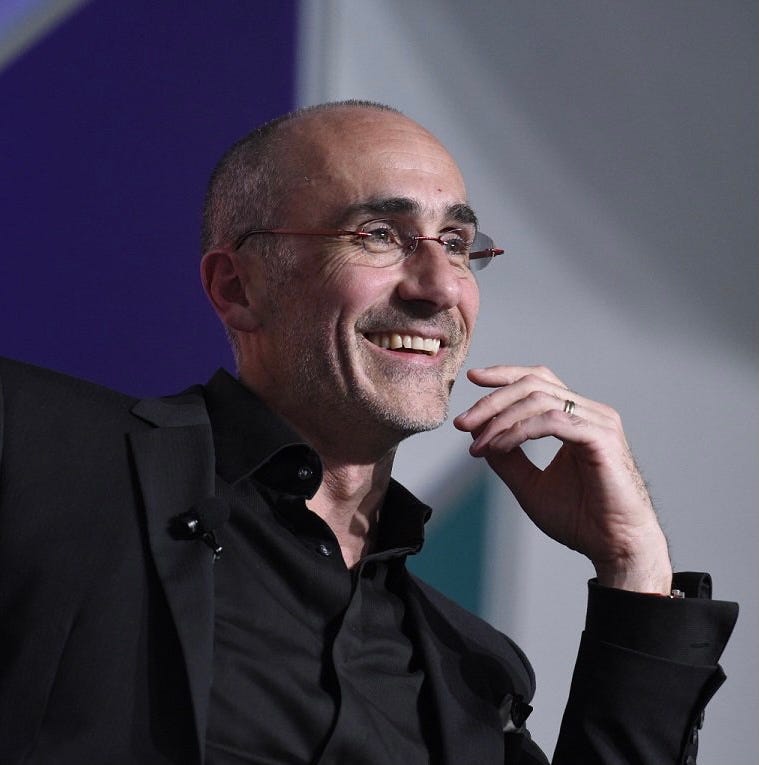
Arthur C. Brooks is a Harvard professor, social scientist, and one of the world’s leading researchers on happiness, meaning, and human flourishing. He teaches at Harvard Business School and the Harvard Kennedy School, where his work focuses on the science of well-being, leadership, and moral development.
Before entering academia full-time, Arthur served as president of the American Enterprise Institute, one of the nation’s leading public policy think tanks. Earlier in his life, he was a professional classical musician — a path that eventually led him to ask deeper questions about ambition, success, and the human search for meaning.
He is a New York Times bestselling author and writes a popular column on happiness and life for The Atlantic. His books blend rigorous behavioral science with philosophy and spirituality, offering practical frameworks for building lives marked not just by achievement, but by coherence, purpose, and significance.

Thank you for this! It’s a realization we don’t often ponder - that suffering might have value. That being tested or tormented or tried at any point in our lives could ever bring us to a place of meaning and put us in a position to help others. It’s a tough thing to see yourself change and evolve - especially from a bad place. I think we always question the authenticity of it - the reality or longevity of it. Like…can I really become this better version of myself? If I see myself improving, can I continue long enough to actually be that person or is it all a sham? An aspiration that will surely implode on itself, leaving me buried deeper in the wreckage I tried to pull myself out of.
Right now, I’m trying to find meaning in my family and also trying to ignore any anxieties around negative events that could someday take me away from them. I’m also trying to let my life flow instead of force-fitting it into the mold I’ve spent my whole life pouring into. It’s one step forward, two steps back. I make a move, I question it. I step back long enough for everything to go quiet. Then I take another step. Someday, I’ll get to where I’m going.
I love the reframing of suffering as a source of growth, depth, and transformation. I often think of this through a physics lens. Pressure alone doesn't create propulsion. It's the release of that pressure that generates movement. There's something really powerful here about transmutation, suffering not just being endured, but transformed into something that moves us forward.